
Meta Description: Confused by NIFTY 50 vs Sensex? Discover the key differences, how they track the Indian economy, and which one you should follow for your investments.
Ever wondered why news anchors get excited when the “market” hits an all-time high? Did you know that when people talk about “the market,” they are actually referring to two specific barometers called the NIFTY 50 and the Sensex?
At its core, the answer to NIFTY 50 vs Sensex: What’s the Difference? lies in their origin and the number of companies they track. While both represent the “health” of the Indian economy, they belong to different stock exchanges and use different numbers of stocks to calculate their value.
In this guide, you will learn exactly how these indices work, why their numbers look so different (like 24,000 vs 80,000), and how you can use them to make smarter investment decisions.
What is NIFTY 50 vs Sensex: What’s the Difference? (For Beginners)
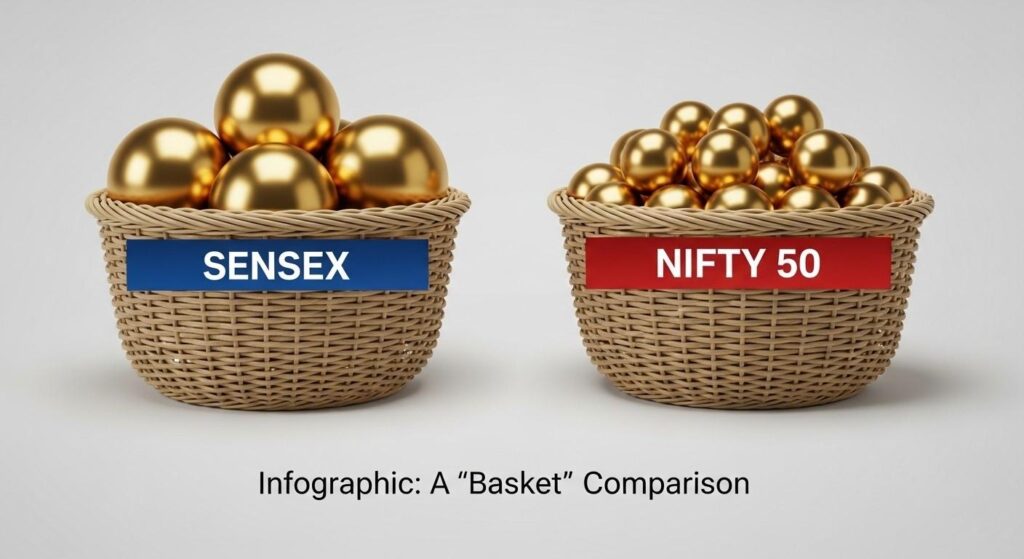
To understand this, imagine you are at a fruit market. Instead of checking the price of every single fruit, you look at a “basket” of the best 30 fruits or the best 50 fruits to see if prices are generally going up or down.
The Sensex
The Sensex, short for Stock Exchange Sensitive Index, is the oldest index in India. It was launched in 1986 by the BSE (Bombay Stock Exchange). It tracks the performance of the 30 largest and most financially sound companies listed on the BSE. These are often called “Blue-chip” companies.
The NIFTY 50
The NIFTY 50 (National Index Fifty) is the flagship index of the NSE (National Stock Exchange). As the name suggests, it tracks the top 50 companies across various sectors of the Indian economy. It was introduced in 1996 and is widely used by derivative traders.
Key Jargon Explained:
- Index: A statistical measure that tracks the performance of a group of stocks.
- Market Capitalization: The total value of all a company’s shares. (Price per share × Total number of shares).
Free-float: Only the shares of a company that are available for the public to trade (excluding promoter holdings).
Why NIFTY 50 vs Sensex: What’s the Difference? Matters for Traders (India Context)
For an Indian investor, these aren’t just numbers; they are the pulse of your portfolio. If you own shares of Reliance Industries, HDFC Bank, or Infosys, their movement directly impacts both indices because these “heavyweights” are present in both.
Relevance for the Indian Market:
- Economic Indicator: When the NIFTY 50 or Sensex goes up, it usually means investors are confident about India’s growth.
- Benchmarking: If your personal portfolio grew by 10% this year, but the NIFTY 50 grew by 15%, you are actually underperforming the market.
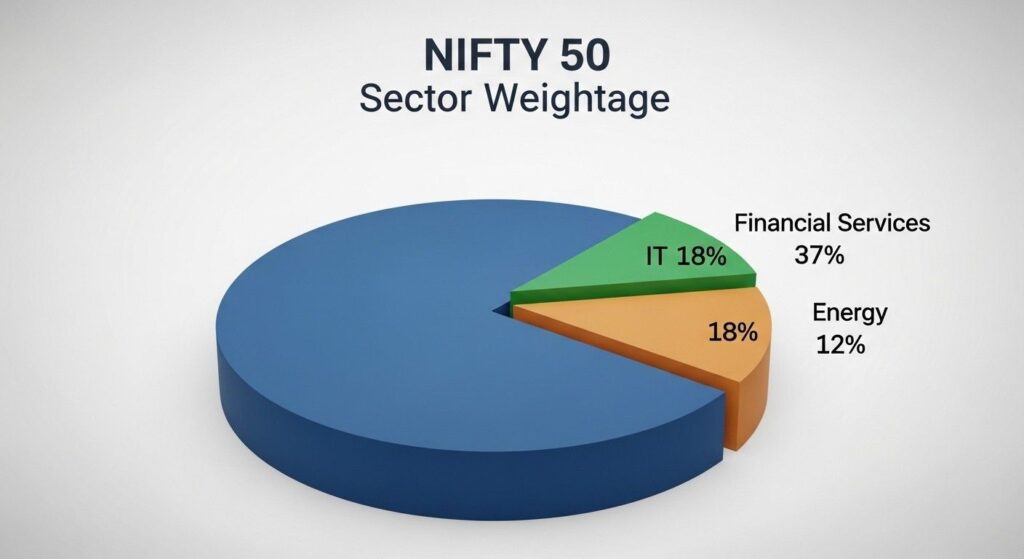
- Sector Representation: The NIFTY 50 covers about 13-14 sectors of the economy, providing a slightly broader view than the Sensex.
Alt text: Comparison of NIFTY 50 and Sensex showing the number of stocks and their parent exchanges.
How to Use NIFTY 50 vs Sensex: What’s the Difference? (Step by Step)
You don’t just “watch” these indices; you can actually use them to build wealth. Here is how:
Step 1: Use them as a Trend Indicator
Before you buy any individual stock, check the “market sentiment.”
- If both indices are in “the red” (falling), it might be a risky time for short-term trades.
- Check the Advance-Decline ratio on the NSE website to see if more stocks are rising than falling.
Step 2: Invest via Index Funds or ETFs
You cannot buy “one unit” of NIFTY directly like a share, but you can buy Index Funds.
- An Index Fund mimics the NIFTY 50. If the NIFTY goes up 1%, your fund goes up roughly 1%.
- This is perfect for beginners because it offers instant diversification across 50 companies with very low fees.
Step 3: Monitor “Weightage”
Not all stocks in the index are equal.
- A 1% move in a heavy company like Reliance will move the NIFTY more than a 5% move in a smaller index company.
- Action: Keep an eye on the top 5 companies in the index; they usually dictate where the market goes.
Common Mistakes to Avoid
- Confusing Points with Percentage: Beginners often panic when Sensex falls “500 points.”
- Why it happens: 500 points on a 80,000-level index is less than 1%.
- The Fix: Always look at the percentage change, not the absolute points.
- Assuming they are identical: While they usually move together, they can diverge.
- Why it happens: Because NIFTY has 20 more stocks than Sensex, it might stay stable while Sensex drops if those extra 20 stocks are performing well.
- Chasing the All-Time High: Buying just because the index hit a record high without checking valuations.
- The Fix: Check the P/E (Price-to-Earnings) ratio of the NIFTY 50 to see if the market is “expensive.”
India vs USA Comparison
The concept of a stock index is universal, but the names change.
| Feature | India | USA |
| Main Large-Cap Index | NIFTY 50 | S&P 500 |
| Oldest/Narrow Index | Sensex (30 stocks) | Dow Jones (DJIA) (30 stocks) |
| Tech-Heavy Index | Nifty IT | NASDAQ 100 |
| Exchange focus | NSE & BSE | NYSE & NASDAQ |
Actionable Tips
- Start an SIP in a NIFTY 50 Index Fund: It’s the easiest way to “own” the top 50 companies of India.
- Download a Market App: Use apps like Moneycontrol or Groww to set alerts for when the NIFTY moves more than 2%.
- Ignore the daily “noise”: If you are a long-term investor, daily fluctuations in Sensex points don’t matter as much as the yearly trend.
- Watch the Global Markets: Often, if the US market (S&P 500) falls at night, our NIFTY 50 opens lower the next morning.
Understand Beta: Learn about “Beta,” which tells you how much a specific stock moves compared to the NIFTY 50.
Q1: Which is better, NIFTY 50 or Sensex?
Neither is “better.” They both track the same top companies. However, NIFTY 50 is more popular among traders due to its higher liquidity in the derivatives (F&O) market.
Q2: Why is the Sensex value much higher than the NIFTY 50?
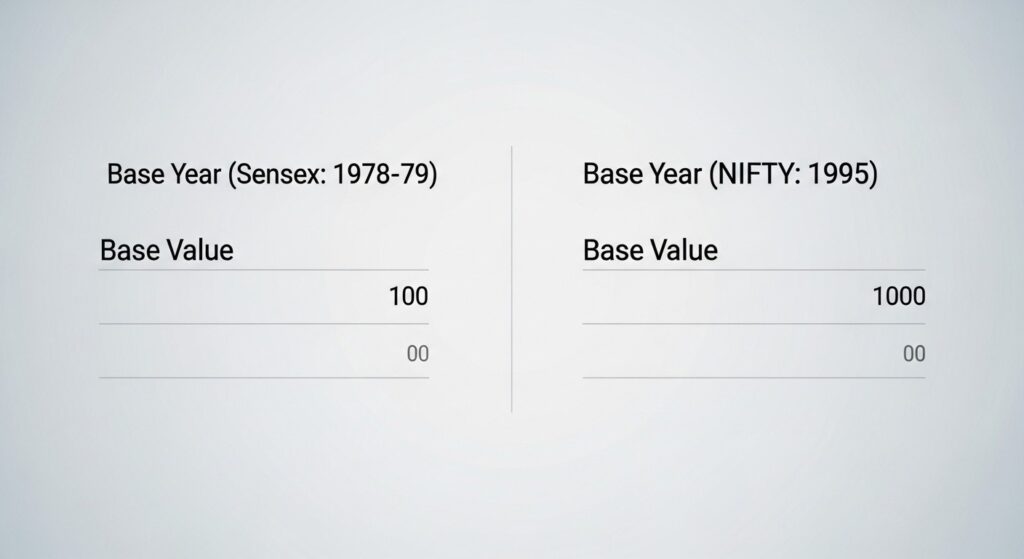
It’s simply because of their starting points. Sensex started earlier (1979) with a base of 100, while NIFTY started later (1995) with a base of 1000. It’s like comparing kilometers to miles; the scale is just different.
Q3: Can a company be in both NIFTY and Sensex?
Yes! In fact, most of the 30 companies in the Sensex are also part of the NIFTY 50.
Q4: How often do these indices change their stocks?
Both indices are rebalanced semi-annually (twice a year). Companies that underperform are removed, and rising stars are added.
Q5: Does a falling NIFTY mean I am losing money?
Only if you own the stocks that are falling. However, if you own an Index Fund, your investment value will mirror the index’s movement.
Conclusion
Understanding NIFTY 50 vs Sensex: What’s the Difference? is like learning to read the scoreboard of a cricket match. One tells you the runs (Sensex), and the other might give you more detail on the run rate and wickets (NIFTY 50). Both are essential for understanding who is winning. For a beginner, following either is a great way to stay informed about India’s economic journey.
Which index do you find easier to track for your portfolio? Comment below!