
Meta Description: Confused between a Demat and Trading account? Learn the key differences, how they work together in India, and the steps to open yours today. Start investing now!
Ever wondered why you need two different accounts to buy just one share of Reliance or Tata Motors? Did you know that while one acts like your digital locker, the other acts as your gateway to the stock market?
Understanding the Demat Account vs Trading Account: Key Differences is the first step for any aspiring investor. Many beginners think they are the same, but using them correctly is the “secret sauce” to a smooth investing experience. In this guide, we will break down their functions, how they interact within the Indian ecosystem (NSE/BSE), and how you can set them up to build your wealth.

What is Demat Account vs Trading Account: Key Differences? (For beginners)
To put it simply, think of your stock market journey like a shopping trip.
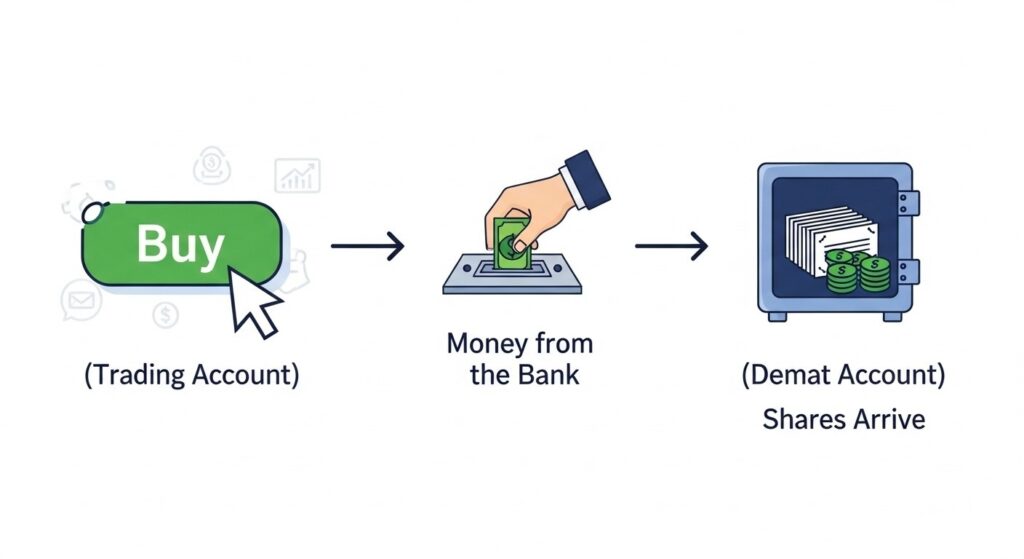
A Trading Account is like your shopping cart. It is the platform you use to place “buy” or “sell” orders. When you see a stock price moving on your screen and hit the ‘Buy’ button, your Trading Account is doing the work.
A Demat Account (short for Dematerialized Account) is like your digital safe or locker. Once you buy those shares, they need a place to stay. In the old days, investors got physical paper certificates. Today, your Demat account holds these shares in electronic form, keeping them safe from theft or loss.
Alt text: Diagram showing the connection between Bank, Trading, and Demat accounts during a stock transaction.
The Main Distinctions:
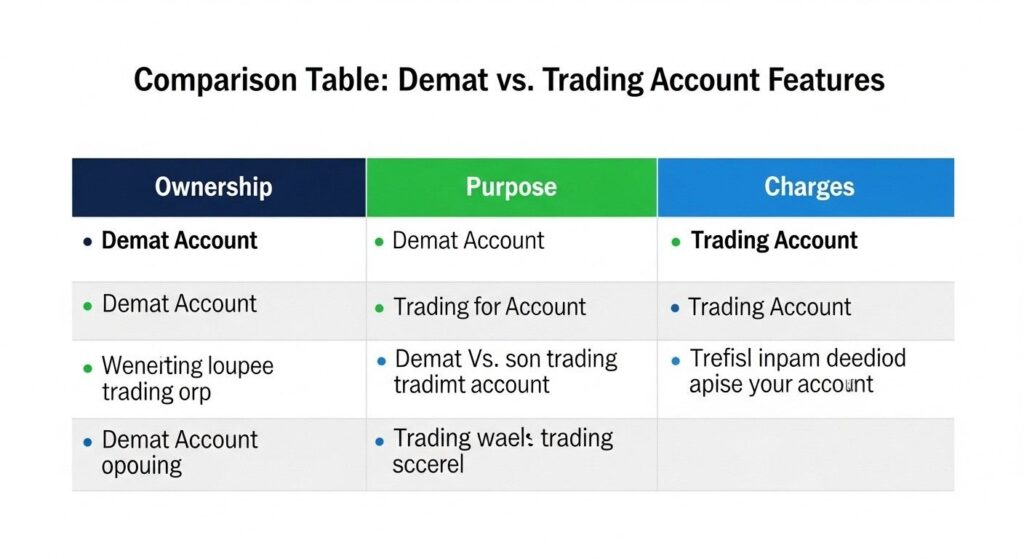
- Purpose: Trading accounts facilitate the transaction; Demat accounts facilitate storage.
- Nature: Trading is a “flow” account (money/shares move through it); Demat is a “store” account.
- Stamp Duty: Usually payable on the transfer of shares held in Demat, whereas Trading accounts involve brokerage and transaction charges.
Why Demat Account vs Trading Account: Key Differences Matters for Traders (India context)
In the Indian market, regulated by SEBI (Securities and Exchange Board of India), the distinction is vital because of how our settlement cycle works.
Whether you are trading on the NIFTY 50 or the Sensex, India currently follows a T+1 settlement cycle. This means if you buy a share today, it should reflect in your Demat account by the next business day.
Why the distinction matters:
- IPO Applications: You only need a Demat account to apply for an IPO, but you need a Trading account to sell those shares once they list.
- Equity vs. F&O: If you only trade Intraday or Futures & Options (F&O), you might not even use your Demat account much because you aren’t “holding” the stocks overnight.
- Safety: By keeping these accounts separate, the Indian system ensures that your “holdings” (Demat) are separated from your “speculations” (Trading).
How to Apply/Use Demat Account and Trading Account (Step by Step)
Opening these accounts in India has become incredibly fast thanks to e-KYC. Most brokers now offer a “2-in-1” account which opens both simultaneously.
Step 1: Choose a SEBI-Registered Broker
You need to pick a Depository Participant (DP). In India, these are usually linked to either NSDL or CDSL.
- Research brokerage charges (flat fee vs. percentage).
- Check the user interface of their mobile app.
- Tip: Look for brokers with “Zero Delivery Brokerage” if you plan to hold stocks long-term.
Step 2: Documentation and e-KYC
Keep your digital copies ready. You cannot trade in India without these:
- PAN Card (Mandatory).
- Aadhaar Card (Linked to your mobile number for OTP).
- Bank Account Proof (Cancelled cheque or 6-month statement).
- Income Proof (Only if you want to trade in Derivatives/F&O).
Step 3: Verification and Activation
- Complete the In-Person Verification (IPV) via a short video or webcam.
- Digitally sign your document using Aadhaar-based e-Sign.
- Once verified, your BOID (Beneficiary Owner ID) for Demat and Trading ID will be generated within 24-48 hours.
Common Mistakes to Avoid
- Forgetting the Nominee: Many beginners skip the “Nominee” section. If something happens to you, your family might face a legal nightmare to access your Demat holdings. Fix: Add a nominee during the digital sign-up.
- Confusing Dividend Payouts: Beginners often look for dividends in their Trading account. Fix: Dividends are sent directly to the Bank Account linked to your Demat, not the Trading account.
Ignoring AMC (Annual Maintenance Charges): Even if you don’t trade, your Demat account might have a yearly fee. Fix: Choose a “Basic Services Demat Account” (BSDA) if your holdings are small (under ₹2 Lakhs).
India vs USA Comparison
While the concept is similar, the structure in the US is slightly different for retail investors.
| Feature | India (NSE/BSE) | USA (NYSE/NASDAQ) |
| Account Structure | Strict separation between Demat and Trading. | Usually a unified “Brokerage Account.” |
| Storage | Held with central depositories (NSDL/CDSL). | Often held in “Street Name” by the broker. |
| Regulator | SEBI | SEC & FINRA |
| Settlement | T+1 Cycle | T+1 Cycle (Recently updated) |
Visual Elements Suggestions
Actionable Tips
- Link one primary bank account: Use a single bank account for all transfers to keep your tax filing simple.
- Enable Two-Factor Authentication (2FA): Protect your Trading account with biometric or TOTP locks to prevent unauthorized trades.
- Check your Consolidated Account Statement (CAS): Review the monthly statement sent by NSDL/CDSL to verify your actual holdings.
- Start with Index Funds: If you are nervous about picking stocks, use your Trading account to buy an Index ETF like NIFTYBEES.
- Clean up dormant accounts: If you have multiple Demat accounts you don’t use, close them to save on AMC.
Q1: Can I have a Demat account without a Trading account?
Yes. If you only intend to buy and “hold” (like in an IPO) or receive shares as a gift, you can have just a Demat account. However, to sell those shares, you will eventually need a Trading account.
Q2: Are there any charges for opening these accounts?
Many modern discount brokers offer zero-cost account opening. However, always check for hidden “Annual Maintenance Charges” (AMC).
Q3: Many modern discount brokers offer zero-cost account opening. However, always check for hidden “Annual Maintenance Charges” (AMC).
Most brokers allow you to link one “Primary” bank and multiple “Secondary” banks. Funds can be added from any, but withdrawals usually go only to the Primary account.
Q4: What is a BOID?
The BOID (Beneficiary Owner Identification Number) is a unique 16-digit number assigned to your Demat account. It is your identity in the eyes of the depository (CDSL/NSDL).
Q5: Is it safe to keep shares in a Demat account?
Yes, it is very safe. Even if your broker goes bust, your shares are held by the central depository (NSDL or CDSL), not the broker itself.
Conclusion
Navigating the Demat Account vs Trading Account: Key Differences is essential for your financial literacy. To summarize: your Trading account is where the action happens, and your Demat account is where the results are stored. Together, they form the backbone of your investment journey in India.
Ready to start your wealth-building journey? The best time to start was yesterday; the second-best time is today!
Which strategy will you try first: Long-term investing in your Demat or active Trading? Comment below!
Is there any company which offer an interest free business ?