
Did you know that less than 5% of India’s population currently invests in the stock market? While that number is growing rapidly, many people stay on the sidelines because they think trading is too complicated or risky.
How to start trading in India simply involves setting up a Demat and Trading account, linking your bank, and understanding the basics of the stock market. Whether you want to build a long-term portfolio or try your hand at day trading, the Indian market offers incredible opportunities for those who are prepared.
In this comprehensive guide, you will learn everything from selecting the right broker to executing your first trade. We will break down complex jargon into simple steps so you can navigate the NSE and BSE with confidence.
What is Trading in India? (For Beginners)
At its simplest, trading is the act of buying and selling financial instruments like stocks, bonds, or currencies to make a profit. Unlike long-term investing—where you might hold a stock for a decade—trading often involves shorter timeframes.
In India, most trading happens on two main stock exchanges:
- NSE (National Stock Exchange): The largest exchange where the NIFTY 50 index resides.
- BSE (Bombay Stock Exchange): The oldest exchange in Asia, home to the Sensex.
When you trade, you are essentially betting on the price movement of a company. If you buy a share of Reliance Industries at ₹2,500 and sell it at ₹2,600, you’ve successfully completed a trade.
Why “How to Start Trading in India” Matters for You
The Indian economy is one of the fastest-growing in the world. By learning how to start trading in India, you are positioning yourself to participate in this growth.
• Beating Inflation: Keeping money in a savings account often yields 3-4%, while inflation might be 6%. Trading allows for potentially higher returns.
• The Power of NIFTY & Sensex: These indices represent the health of India’s top companies. When India grows, these indices usually climb, offering a roadmap for your trades.
• Accessibility: With the rise of discount brokers and mobile apps, you can now start trading from a small village in India just as easily as someone in Mumbai or New York
How to Start Trading in India: Step-by-Step
Starting your journey doesn’t have to be overwhelming. Follow these five clear steps to get your first trade across the line.
Step 1: Get Your Documents Ready (KYC)
Before you can trade, the Government of India requires specific documentation for Know Your Customer (KYC) compliance. This ensures security and prevents fraud.
• PAN Card: This is mandatory for all financial transactions in India.
• Aadhaar Card: Used for digital e-sign and identity verification.
• Bank Account: You need an active savings or current account to transfer funds.
• Canceled Cheque/Bank Statement: Usually required to verify your IFSC code and account number.
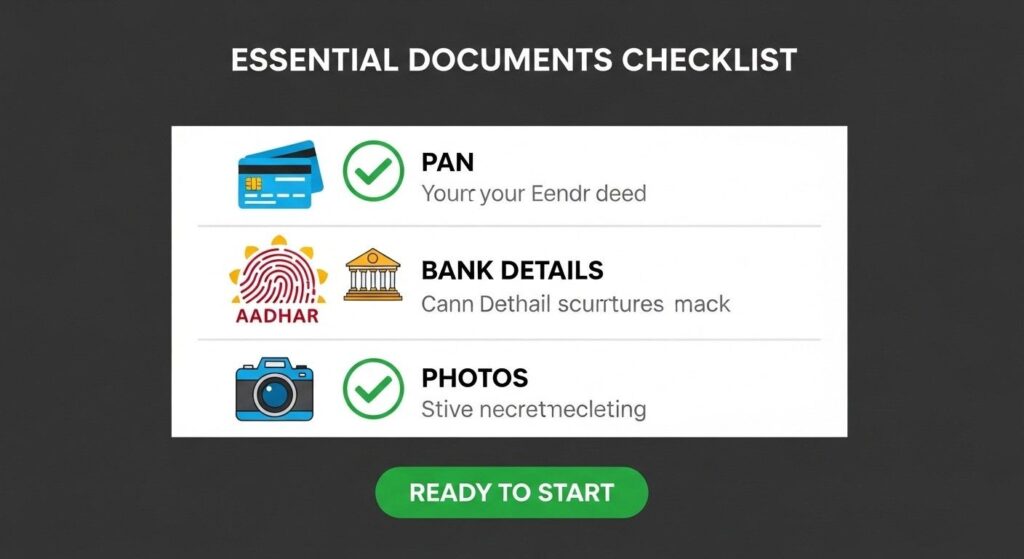
Alt-text: Documents required to start trading in India checklist.
Step 2: Choose a Stockbroker and Open an Account
You cannot buy stocks directly from the exchange; you need a middleman called a stockbroker. In India, you have two choices:
• Discount Brokers (e.g., Zerodha, Groww): They charge low flat fees (usually ₹20 per trade) and provide great tech apps. Perfect for beginners.
• Full-Service Brokers (e.g., ICICI Direct, HDFC Securities): They charge a percentage of your trade but offer research reports and personal advisors.
Once you pick one, you will open a 2-in-1 account:
- Trading Account: To buy and sell.
Common Mistakes to Avoid
Even the best traders make mistakes, but you can avoid these common pitfalls:
• Overtrading: Beginners often place too many trades in one day out of excitement. This leads to high brokerage costs and emotional exhaustion.
o Fix: Limit yourself to 1 or 2 trades per day initially.
• Ignoring Stop-Loss: A Stop-Loss is an automatic order that sells your stock if the price drops to a certain level.
o Fix: Never enter a trade without setting a Stop-Loss to protect your capital.
• Chasing “Hot Tips”: Telegram and WhatsApp groups are full of fake tips designed to manipulate stock prices.
o Fix: Do your own research or follow SEBI-registered advisors.
India vs. USA: Trading Differences
If you are following global news, it’s important to know how the Indian market differs from the US market (like the NYSE or NASDAQ).
Feature India (NSE/BSE) USA (NYSE/NASDAQ)
Market Timing 9:15 AM – 3:30 PM IST 9:30 AM – 4:00 PM EST
Currency Indian Rupee (INR) US Dollar (USD)
Settlement T+1 (Next day) T+1 (Next day)
Regulator SEBI SEC
Fractional Shares Not allowed (Must buy 1 full share) Allowed (Can buy 0.5 of a share)
Actionable Tips for Today
- Download a Trading App: Install a top-rated app like Zerodha or Groww just to explore the interface.
- Complete your KYC: Get your PAN and Aadhaar linked to your mobile number for a paperless setup.
- Start a Watchlist: Add 5 stocks you use in daily life (e.g., Tata Motors, Asian Paints) and watch their price for a week.
- Read one Financial News daily: Visit The Economic Times to understand what moves the market.
- Use a Simulator: Try “Paper Trading” apps where you can practice with virtual money before risking real cash.
Q1: How much money do I need to start trading in India?
There is no minimum limit. You can start with as little as ₹100 or ₹500 by buying a single share of a low-priced company.
Q2: Is trading the same as gambling?
No. While both involve risk, trading is based on data, company performance, and economic trends. Gambling relies purely on chance.
Q3: Can I trade from my mobile phone?
Yes! Most Indian brokers have world-class mobile apps that allow you to trade, analyze charts, and manage funds on the go.
Q4: Do I have to pay tax on trading profits?
Yes. Profits are taxed as Capital Gains. Short-term (less than 1 year) is usually taxed at 20%, and long-term (more than 1 year) at 12.5% (above ₹1.25 lakh profit).
Q5: What are the market timings in India?
The equity market is open Monday to Friday from 9:15 AM to 3:30 PM. The market is closed on weekends and public holidays.
Conclusion
Starting your trading journey in India is a marathon, not a sprint. By following this step-by-step guide, you’ve already taken the most important step: education. Remember to start small, keep learning, and always manage your risks. The Indian market is full of potential—now is the time to claim your share of it.
Which stock are you planning to buy for your first trade? Comment below and let’s discuss!
Related Article: [Top 5 Technical Indicators for Beginners]