
Ever wondered why some investors sleep peacefully while others are glued to their screens until 3:30 PM every day? Did you know that the “best” way to trade depends entirely on your risk appetite and how much time you can spare?
The debate of Delivery Trading vs Intraday: Which is Better? is a classic one. Delivery trading is like buying a house to live in—you own it for the long term. Intraday is like “flipping” a product for a quick profit within hours. In short, Delivery is for wealth creation, while Intraday is for generating daily income.
In this comprehensive guide, we will break down the mechanics of both styles, the costs involved, and the risks you need to manage. Whether you are looking at the NIFTY 50 for a long-term SIP or trying to catch a quick move in Tata Motors, this article will help you choose your path.
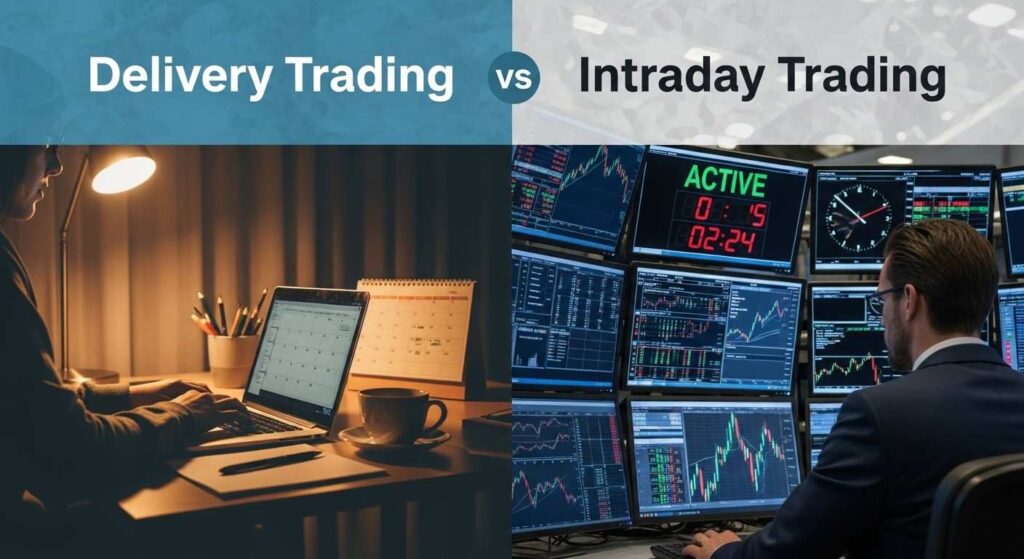
What is [Delivery Trading vs Intraday: Which is Better?]? (For beginners)
Before we compare them, let’s define these two worlds in the simplest way possible.
What is Delivery Trading?
In Delivery Trading, you buy shares and hold them for more than one day. These shares are transferred to your Demat account. You become a partial owner of the company. You can hold them for weeks, months, or even decades. You only sell when you are happy with the profit or need the money.
What is Intraday Trading?
Intraday Trading requires you to buy and sell your stocks within the same trading session. In India, if you don’t close your position by around 3:15 PM, your broker will do it for you automatically. You are not buying the “company”; you are merely betting on the price movement of the day.
Key Differences at a Glance:
• Ownership: You own shares in Delivery; you only hold a “position” in Intraday.
• Timeframe: Long-term vs. 6 hours and 15 minutes.
• Capital: You need the full amount for Delivery; you get Leverage (Margin) for Intraday.
Why [Delivery Trading vs Intraday: Which is Better?] Matters for Traders (India context)
In the Indian market, the choice you make affects your taxes, your brokerage, and your mental peace.
The Indian Context:
- Brokerage Charges: Most discount brokers in India charge ₹0 for Delivery trades but charge a flat fee (like ₹20) for Intraday. This makes Delivery very attractive for long-term investors.
- STT (Securities Transaction Tax): The government charges higher STT on Delivery trades than on Intraday.
- Market Volatility: Indian stocks can be sensitive to global cues (like the US Fed) and local news (like RBI meetings). Intraday traders love this volatility, while Delivery investors usually ignore the daily “noise.”
For example, if you bought Reliance shares in 2020 and held them (Delivery), you benefited from massive growth and dividends. If you traded it Intraday, you might have made money on some days and lost on others, depending on your skill.
How to Apply [Delivery Trading vs Intraday: Which is Better?] (Step by Step)
Deciding which to use depends on your specific goal. Here is how to navigate both.
Step 1: Assess Your Capital and Time
• For Delivery: You need enough money to buy the shares at full price. If a share costs ₹2,500, you pay ₹2,500. This is best if you have a full-time job and cannot watch the market every minute.
• For Intraday: You can start with less money because of Margin. However, you MUST be able to watch the charts from 9:15 AM to 3:30 PM.
Step 2: Selecting the Right Stocks
• Delivery Picks: Focus on Fundamental Analysis. Look at the company’s profit, debt, and management. You want “Blue-chip” stocks like TCS or HDFC Bank.
• Intraday Picks: Focus on Technical Analysis and Liquidity. You need stocks that move a lot (High Volatility) and have many buyers/sellers (High Volume) so you can exit quickly.
Step 3: Execution and Monitoring
• In Delivery: You place a “CNC” (Cash n Carry) order. Once bought, you can relax. You only need to check back occasionally.
• In Intraday: You place an “MIS” (Margin Intraday Square-off) order. You must set a Stop Loss immediately to protect your capital if the trade goes against you.
Common Mistakes to Avoid
• Turning a Bad Intraday Trade into Delivery: This is the #1 mistake. When a day trade goes into loss, beginners often say, “I’ll just hold it for a few days.”
o The Fix: If your Intraday logic failed, exit. Don’t force yourself to become an investor in a bad stock.
• Ignoring the “Exit” Plan in Delivery: Even long-term investors should know when to sell.
o The Fix: Review your portfolio every 6 months to ensure the company is still performing well.
• Over-leveraging in Intraday: Using 5x margin doesn’t mean you should use your whole capital.
o The Fix: Never risk more than 1-2% of your total account value on a single day trade.
India vs USA Comparison
The structural differences between the two markets are important for those following global trends.
| Feature | India (NSE/BSE) | USA (NYSE/NASDAQ) |
| Brokerage | Delivery is often free; Intraday is flat-fee. | Most brokers offer $0 commission for both. |
| Settlement | T+1 (Shares arrive in Demat next day). | T+1 (Recently moved from T+2). |
| Day Trading Rules | Anyone can do Intraday with any amount. | PDT Rule: Need $25,000 to be a “Pattern Day Trader.” |
| Margin | Regulated by SEBI (Usually 5x for Intraday). | Regulated by FINRA (Usually 4x for Intraday). |
Visual Elements
- Image 1 (Comparison Table): A high-quality table showing “Delivery vs Intraday” across parameters like Risk, Time, and Reward.
- Alt Text: Detailed comparison table of Delivery and Intraday trading.
- Image 2 (Flowchart): A decision-making flowchart: “Do you have time to watch the market?” -> If No -> Delivery.
- Alt Text: Decision flowchart for choosing between trading styles.
- Image 3 (Profit/Loss Scenario): A chart showing how a 2% move affects a Delivery trade vs. a 5x Leveraged Intraday trade.
- Alt Text: Impact of leverage on stock market profits and losses.
Actionable Tips
- Start with Delivery: If you are a total beginner, stay with Delivery for 3-6 months to understand how stocks move.
- Use “Limit Orders”: Whether doing Delivery or Intraday, always specify the price you want to buy at; never buy at “Market” price during high volatility.
- Keep Separate Accounts: If possible, use one broker for long-term Delivery and another for Intraday to keep your emotions and math separate.
- Understand Dividend Dates: In Delivery, you only get the dividend if you hold the stock on the “Record Date.” Intraday traders do not get dividends.
Check the “Total Cost”: Use an online brokerage calculator to see the impact of GST, STT, and SEBI charges on your trade.
Q1: Which is riskier: Delivery or Intraday?
Intraday is generally riskier because you have a very short time to be right. In Delivery, you can wait for the market to recover if the price drops.
Q2: Can I convert an Intraday trade to Delivery?
Yes, most Indian brokers allow you to convert MIS to CNC if you have the full cash amount available in your account.
Q3: Do I need a Demat account for Intraday?
Technically, no, as shares aren’t stored overnight. However, in India, brokers require you to open a Demat and Trading account together to get started.
Q4: Is there a minimum amount for Delivery trading?
No. You can buy even a single share of a company for as little as ₹10 or ₹100
Q5: Which one is better for tax saving?
Delivery is usually better. If you hold shares for more than one year, you pay LTCG (Long Term Capital Gains) tax, which has a ₹1.25 Lakh exemption limit. Intraday profit is taxed according to your income tax slab.
Conclusion
So, in the battle of Delivery Trading vs Intraday: Which is Better?, the winner is… you. It depends on your personality. If you want to build wealth slowly and safely, Delivery is your best friend. If you want the thrill of the market and have the discipline to handle risk, Intraday might be for you.
Many successful investors do both—holding a solid “core” portfolio in Delivery while using a small portion of their capital for Intraday trading.
Which strategy will you try first: The patience of Delivery or the speed of Intraday? Comment below!
Related Article: [What is Intraday Trading? Risks and Rewards]